Showing posts with label Genius. Show all posts

Wednesday, May 13, 2015

The Writer’s Maze: Hoedown with Words


I’ve always considered writing a dance between raw imagination and gained knowledge, but recently I’ve decided it’s a very specific type of dance. A hoedown.

Wait. Wait. Don’t go! This isn’t a sleazy post about women with loose morals or about rednecks partying down south. Here, listen to the most famous hoedown (so you’ll feel more comfortable with the subject) by Aaron Copland, it’s been completely commercialized.

Aaron Copland – Hoedown - Posted on YouTube by solutioncow

Now, you get it. You see where I’m going with this, right?
Writing is a journey (hence my URL) which takes the writer (unwillingly kicking and screaming sometimes) on the insane roundabout, duple time dance. The crazy, furious highs where the words flow so fast your fingers can hardly keep up…

…only to drop us off a cliffhanger and leave us dangling for hours, days, years (!) sometimes, just praying for the inspiration to return and spin us around the next corner.
 It’s maddening.
One moment we’re on this high, praising ourselves for our creative genius.

And the next we’re sniveling into our trough-sized wine glasses, convinced we’re phony, no-good writer hacks who will never again write anything worth reading.

Oh, but wait! Here comes the brilliance again, grabbing us by the hand and swinging our fingers around the keyboard in a firestorm of dosey-doe.  
 

Bugs Bunny's Square Dance 'Hillbilly Hare' - Posted on YouTube by Mickey Mouse

And round and round the rollercoaster takes us from high to low, again and again. But here’s the question, which is the truth? Are we a creative genius or a big fat phony? 

The answer is neither. As a writer YOU ARE, I’m sorry to say, like every one of us with our moments of incredible greatness and other times of brain-fart nothingness.
So, where do we go from here? How do we persevere during those dry spells when we can’t make even one word sound right in a simple sentence?
We write anyway.
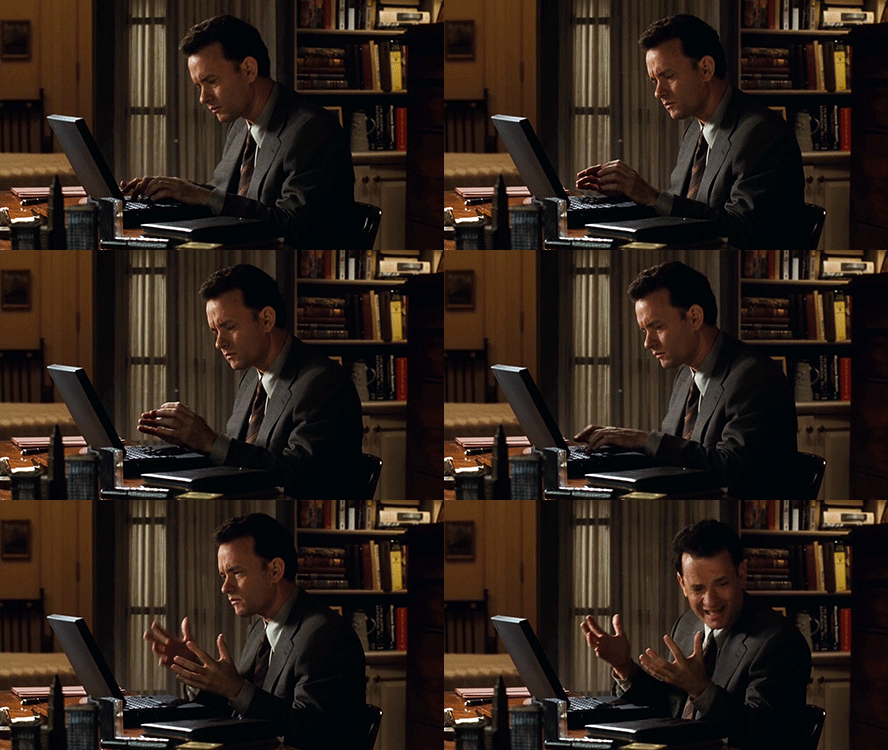
That’s it. That’s the answer. Just write. It doesn’t matter that the words are prettier sometimes more than others. It doesn’t matter that on a good day we can write thousands of words and on others we can barely squeak out a couple hundred. The thing that makes us writers, is that it’s what we do…we write.
Let’s take at look at some people who’ve had moments in their lives, or careers, of truly amazing success.

“Today the word "Einstein" is synonymous with genius, but young Albert didn't speak fluently until he was nine-years-old, causing teachers to think he was slow. He was expelled from school for his rebellious nature and was refused admittance to the Zurich Polytechnic School. He went on to revolutionize science's understanding of the world, taking physics beyond its Newtonian view by developing the theory of General Relativity. He won the Nobel Prize, with his research leading the U.S. to build an atomic bomb, and influenced all aspects of culture, from religion, to art, to late-night television.” ~ CBS News
There’s a whole list of people who might have ended up as nobodies if they would’ve surrendered to the hoedown: Riches to Rags
Once in a while there’s an author who hits it big with a book or two, maybe an entire successful series, only to follow it up with a flop, or maybe they never publish anything ever again. If this is you, don’t settle. Get back to it, remember the magic and make those pages sing. Whoever you are, if writing is what you love, get at it!

Most likely (if you’re reading this blog) you’re just an average Joe, like me, trying to chase a dream and worrying that you’re never gonna make it.
So, here’s the secret. Ready for it?
Learn to dance. 

Don’t tell me you can’t dance, what do you think you’ve been doing thus far? You’ve written down those spurts of masterful prose and you’ve experienced those heart-suffocating moments when the words play hide-and-seek and THAT is what makes you writer. 
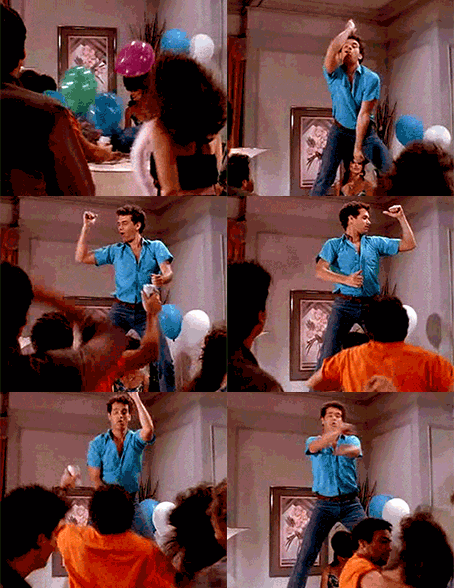
So what are you waiting for? This is it. THIS is what being a writer is all about, surviving the slow beats and hanging on to your britches when the tempo kicks in. Ya ready? Let’s do it.
It’s time for a hoedown, y’all!
Miley Cyrus - Hoedown Throwdown (Movie Scene) - DVD RIP - Posted by phanquanghieu on YouTube
And if you’re still not convinced you can do it. Here’s a little more Miley Cyrus to push you to the top.
Hannah Montana The Movie - The Climb - Posted by Disney IT on YouTube
 Now, get climbing! <3


Sunday, March 29, 2015

The Writer’s Maze: WiPs and Chains


No, I’m not talking about 50 Shades in this episode! Although, that could be fun…
No! No. Get your head out of the clouds and get back to work.

For this installment of The Writer’s Maze I want to talk about our WiPs (for those of you who don’t know, these are not long leather straps that writer’s hit each other with. They’re our ideas, our babies, our Works in Progress). I have about a million of these lyin’ about on various computers and thumb drives. And here’s where we’ll start this maze…
The beginning.
Those very first intimate moments, between writer and a new idea, are glorious. It’s like new love…only better. Because in that first instance when a new idea strikes you think, “Well, that’s it! I am brilliant. Absolutely brilliant. That idea is just so freaking clever, no way anyone’s ever thought of it before.” You walk around in a cloud, putting the milk in the cupboard and the toaster in the fridge, because your left brain is so engaged in the creative juices that you can’t possibly function in the real world. You scribble notes on everything, including the chalkboard on the fridge, the grocery list in your purse, your child’s drawing, until you finally have to begin the outline.
The outline.
Ugh. The outline is where the euphoria starts to wane, but you still think your idea is epic and fresh. You ignore the nagging voice that pipes up saying, “That’s not going to work,” and you fight to keep the initial adrenaline alive. Because you remember what the beginning felt like. And then you wonder, after scrounging all of your scattered notes, what am I forgetting? Was this my original idea? Where is the brilliance?
The middle.
And this is where the chains begin to cinch around your wrists, holding your fingers on the keyboard in stubborn bondage as you kick, scream and cry to make that first idea a reality of literary perfection (NOTE: If you’re chasing literary perfection, give up now, it doesn’t exist). The middle of this maze is the development, the exposition of characters and plot. The setting and world building (because you ignore the giant gaping holes you discovered in your outline phase) where you catch small glimpses of your beginning genius. Your characters might be sound, your dialog intriguing, your sentence structure purple and flowing, but you haven’t yet admitted to yourself that none of these things will matter once you enter the next tunnel of the maze.
The story arc.
And here’s where we grab the eraser and smudge out the notes still glaring at us from the chalkboard on the refrigerator. Once we have grown attached to our protagonist and antagonist and we’re invested in their lives, we realize that our plot and/or subplot don’t really work. There’s no way event A would lead to event B, at least not believably. But, if you’re like me, you tell yourself, “That’s a bunch of crap. Believability comes from good writing. I just have to write it better.” So, on you trudge (ignoring the little voice calling you a fool), peppering your WiP with eloquent prose and vivid details. Though, even your characters are trying to tell you it’s not working.
The ending.
And when you finally reach the page where you get to write THE END, you only feel empty. “I’ll fix it in revision,” you tell the computer screen. But the roiling pit in your stomach begs you to just junk the entire manuscript and save yourself the months of head-banging frustration that is sure to come with plot holes the size of the Hoover Dam. In the end, whether the manuscript is good or bad, you set it aside (because this is the best advice, honest) and put it out of your head for a month or two (or longer depending on if you’ve moved on to your next WiP or not).
Revision.
This is a very long (for some, not for all) process, because in this portion of the maze you find conflicting directions and can actually find yourself roaming around in circles with no idea of how to get through. In the revision phase you tweak and fuss, cleaning up every little corner, but no matter how much you sweep away the garbage and fluff up the grit, you still seem to find something else that could be improved. It never ends. But BEWARE you can tweak too much and do more damage than good. The best idea is to revise with intent.
Revising with intent.
·         Allow yourself a set number of revisions before you send the WiP to critique partners and beta readers. I do about 3 revisions for this phase.
·         One, big picture layout. Does the story follow the formula for that genre? Is the story pacing right for that genre? Is the story following the arc, or does it meander off track (my nemesis)?
·         Two, authenticity of character and dialog. World building. Is it all believable?
·         Three, tidy up grammar and messy tidbits left over from previous revisions.
Now, send it off to someone else. This is, perhaps, the most important part of the writing process. The part where you, the writer, do nothing but chew your fingernails off while you wait – stalking your inbox hourly – to hear what your trusted friends and allies thought of your “brilliance.” Again, I must warn you. DO NOT OVERTHINK this. You want your crit partners to rip it apart, of course we all hope they don’t need to, but the reality is that if they don’t they’re probably not being honest (in which case you need new crit partners). Yes, you want to know if your WiP has potential and yes you want to know that your idea – the one that got you jazzed enough to write it in the first place – is solid and worth continuing the revision process. If you get the go-head once your baby comes home, you’re good to begin revising from their notes. And here is my advice on that.
·         DO NOT (under any – okay, most – circumstances) GET OFFENDED. These are the thoughts and honest opinions of people who took the time to read your work (and at this stage it isn’t always easy to get through someone else’s unfinished work) and make detailed suggestions. They are not trying to hurt your feelings or insult you. They are trying to help you find the spots in your WiP that could be stronger. That is all. The best way is to read the comments with an open mind and then walk away. DO NOT go right into revision. Let the comments sink in first, let that knee-jerk reaction settle, and then come back to tackle the process of fixing problems areas.
What to do when you get multiple suggestions. This is inevitable and difficult to navigate. Once you’ve sent your WiP to a handful of people, you’re going to get a bucket-load of conflicting advice back. Some people are going to like your writing just as it is. Here’s where you get to take creative control. That time you took to absorb all of the advice, that’s going to work in your favor here. Now you get to chose, either you’ll decide that first person (the one who insulted your ego) was right, or you can snub your nose at them and ignore their advice. This is entirely up to you. I will tell you though, that some of my best writing has come out of the changes I’ve made to a WiP that I was resistant to. Chose carefully. Don't chain yourself to only one possibility, you might find greatness if you cut the old idea loose.

And now you’ve done it. Congratulations, you’ve clawed your way through this phase of the Writer’s Maze.
The maze continues here: The Writer's Maze: What a Zoo!

Tuesday, November 22, 2011

The Writer's Maze: Ripping Off the Labels

Hi, I'm Dumb Lazy Genius, who are you?

When I started this blog, I wanted to share my struggle as a writer to get published. But I haven’t been completely honest… or rather I haven’t told you my whole story. I started out by telling you about the first novel I wrote, but that’s not where my writing journey truly began.

Please forgive me if this sounds self indulgent - believe me IT"S NOT. It is my only intention to tell this very private story in the hopes it might help someone else by doing so.

I was always different from other people in my family. I didn’t speak until I was two years old. My parents were worried that something was wrong, as the youngest of seven, they found it very strange that I didn’t use the typical baby-babble of mamma, dada, baba etc. though doctors reassured them that I could speak and I would, in my own time.

Finally, something bothered me enough to verbalize my feelings out loud. I was watching Mr. Rogers on TV and the rabbit ears (yes, I’m that old) were directed improperly and the picture was rolling up and up and up until finally I marched into the other room where my parents were playing spoons with a large group of friends, I put my hands on my hips and said, “What is wrong with the horizontal lines on the television?”

I remember this well, because a dozen or so spoons fell to the table with a crash and startled me, I thought I was in trouble. Of course for a two year old who’d never said so much as boo, this must have been a shock. I was deemed the baby genius.

A year after that I was kicked out of my Montessori School… for not being socially ready to attend. I managed to survive kindergarten and first grade. Frustrated that I wasn’t learning anything in the public education system, my parents enrolled me in a private school where I was promptly held back to repeat first grade. 

After a year of [very expensive] private school my parents decided it [I] wasn’t worth it and tossed me back into public school where my friends had moved onto third grade and I was headed to second. This was the year my struggle really began.

My teacher, Mr. Webber, was kind and patient with me as I tried to learn to spell and read, though I could barely read the word the. And then came IQ testing. I remember the tests, I devoured the puzzles and questions – because I didn’t have to read them, they were given verbally – I was actually able to answer the questions. I felt smart. A few weeks later my parents got a phone call from the school, telling them I’d won a national award for my “above genius IQ” and Mensa wanted to meet me and test me again.

My parent’s response, “She’s not that smart, she’s been held back and kicked out of schools. She can’t even read.” 

I was in the hall when they told the principal they weren’t interested in Mensa testing me, “but thank you for the award…” they said. I was not allowed to know my score; they thought it would go to my head. They didn’t want me to think I was smart, when clearly… I wasn’t.

And so it went. Third grade, couldn’t read, couldn’t write [well I could, it was just mirror image backwards] while the rest of the class was learning cursive. I also couldn’t do math, couldn’t remember my multiplication tables, and I couldn’t follow the steps to do long division. But somewhere along the line the teacher realized if she asked me a math question, I could answer. And still I failed every test. Conference after conference for the next two years, teacher’s told my parents I was lazy and dumb even though I clearly wasn’t because I could intelligently communicate verbally. I was labeled obstinate and disobedient, difficult and unfocused. My fourth grade teacher took me in the supply room to slap me after a spelling test because I misspelled my own last name, an offense she saw as a sign of me being deliberately stupid.

During this time in my life, I lived in an imaginary world. I retreated inside myself and made up characters that played with me in the woods behind my house. I was tomboyish and I broke almost every bone in my body… I didn’t understand why a tree house thirty feet above ground wasn’t a good idea; my imaginary friends thought it sounded great. 

Sometime during my fifth grade year, my mother found some Winnie the Pooh record/book combos and thought I might enjoy listening to the stories since I couldn’t read them. I don’t know how she figured it out, but after I listened to those records a gazillion times while following along in the book, I could not only read the books, but I knew the words. My mother rushed to tell my teacher and through their collaborative efforts the school had me tested for dyslexia. 

“Ah ha! She’s not dumb, she’s handicapped.” 

The term “learning disability” didn’t come along until way later.

Seriously, people just didn’t know enough about dyslexia to help. But at least now I had a label, which unfortunately only gave my teachers an excuse for no longer bothering to teach me. But in their ignorance, came my literary salvation and the keys to freedom from dyslexia. While the rest of my class was learning as a group, I sat in the corner of the room – alone – on a beanbag chair with my head phones and a book. I must’ve listened to a thousand books that year. 

Side note: People still ask me how I learned to read with dyslexia on my own. I have to answer the best way I can, I tell them words are like a puzzle to me. I don’t see the picture as individual pieces, but rather as a collective whole. If you ask me how to spell something for you, I will have to write it down first because only my hands know what letters go in each word. My brain doesn’t have a clue. The unexpected bonus to this is that I can read from long distances because I don’t need to see the letters to recognize a word. I see it as a series of high and low shapes, each word has its own look. 

And viola! I could read. 

Albeit, very slowly. 

It didn’t matter to me. I wanted to read, anything! The first book I read completely on my own, was Are You There God? It’s Me Margret by Judy Bloom. It took me about five months. Then I read Kavik the Wolf Dog by Walt Morey, it didn’t get any easier or faster, I had to fight for every story, but it didn’t matter, reading was worth it. Inside each word I learned something… something about the world, something about me and something about other people who didn’t grow up like me.

Although school was a little a better after that, it certainly didn’t fix everything. Math and I still didn’t get along and I still couldn’t spell. Teachers in junior high saw that obnoxious award in my file and wondered why I didn’t have incredible grades and why my paper’s looked like a two year old had written them. I did excel in music though, my first A! I played multiple instruments, despite not being able to read a single note, I never told anyone. 

And then somewhere along the line, a teacher told me I was good at creative writing and that I had a “big imagination.” Then another told me that my vocabulary and comprehension were very high for my age, that if I could just work on my grammar, punctuation and spelling I would have a good paper.

That seed laid and festered for years before sprouting up in college seventeen years later. 

Three weeks into High School, I realized I was in way over my head. I dropped out my freshman year.

I do not recommend this. 

I don’t blame my parents or teachers for their lack of support or understanding. There just weren’t enough resources for anyone to help me.

This is why I’m sharing my sad, shameful secret now. I say shameful, because that’s how I’ve treated it.

I have carried this around with me my whole life, even though I’ve been to college and hold two degrees and I’m working on a third. I’ve made the Dean’s list, the President’s list and my GPA is 3.78. 

Still, in the back of my mind, I am still the Dumb, Lazy Genius. 

Today, that changes!

I have decided I’m not going to wear those labels anymore. 

I’m done hiding. I’m done being too afraid someone will find out that I have dyslexia, that no one will want to publish me or read my books because of it.

If all of these brilliant people can achieve what they’ve achieved, then so can I.

 
If you know someone that struggles with learning, please help them break free from the labels. Dyslexia doesn’t have to be a prison.


If you think you’re a Dumb, Lazy Genius too, check out Mensa.


Thanks for reading this nobody’s fight to overcome the walls of dyslexia.